
Ode to an Aunt
Hagelslag, Tea-cups and Cellos

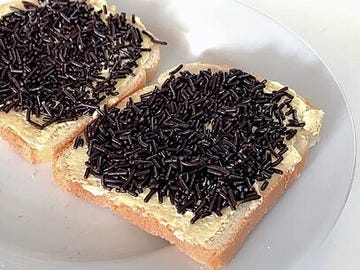
I remember the milk lorry rattling around Huizen with all these coloured chocolate and strawberry milks in its carrier– insanely exciting to me as a child. My Aunt Aedine taught me to say “Look!” in Dutch but I can’t even remember how to say it now. ‘Kook-mal!” is what I remember saying. But I think it’s ‘Kijk!’ The other really exciting thing was hagelslag, sprinkles on toast that was just like sprinkles for cake but it was meant for toast– so that was a thrill. Sort of cake-toast. Or toast-cake. The smell of it. An estimated 750,000 hagelslag sandwiches are eaten daily by the Dutch and 14 million kilograms of hagelslag are consumed each year. What a passtime, heh? Well, the Dutch were the great sea-traders, the bourgeois burghers that claimed their land from the sea. They were also great thieves and colonisers, of course.
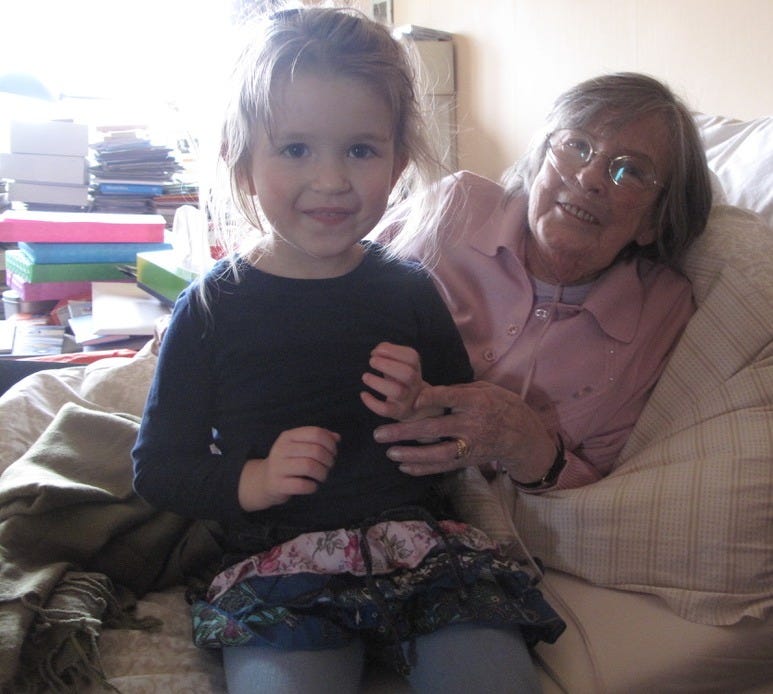
My Aunt Aedine and Uncle Béla lived in Huizen, a sleepy town not too far from Amsterdam and nearer to Bussum, which sounded to me like ‘bosom’. My Aunt told me years later that Bussum was full of evangelical prostitutes, a thing I just couldn’t get my head around. Why and how, I never asked. I think she said something glib like, they could with the money. I could never say Huizen right, either. Béla met my Aunt Aedine at an Irish Hungarian wedding in 1958 and hounded her to marry him and they went on to have four children and a happy life in Huizen.
My cousins are three brothers. Peter, Zoltan David. Uncle Bèla was a cello player from Budapest who sneaked out of Budapest with the orchestra when Papa Stalin came to feast on Hungary. That is what I remember being told, but it seems that story came out of my own head. I’m told he was invited for a masterclass by a Danish friend, but reverted to Ireland to play with the RTE Orchestra and through his Hungarian friend met Aedine at an Irish Hungarian wedding. The year was 1961. But I’m sure it was Bèla who told me once that he knew of a man who carved out the inside of a tree, kept stores in it and took a few steps across fields each day until until he eventually crossed the border and escaped from Papa Stalin. Béla was in the Concertgebouw in Amsterdam for many decades and sold his cello to somebody in New York at the end of his career. Known for his odd humour, he would enquire as you came out of the bathroom, ‘Well well was it a number one or a number two?’ He even laughed a bit like Count Dracula on Sesame Street. It helped that he smoked cigars and went around in a puff of smoke. Definitely my favourite uncle.
The last time I was here, Aedine was slipping away with cancer. We had long chats about life before marriage, the quirks of Holland and childhood pranks my father played as a child. (Such as pee-ing in his brother Gerry’s milk over time, and then admitting it, which had the effect of Gerry’s life-long repulsion for milk). God only knows what went through my father’s mind.
The last thing I expected Aedine to do was to die but she did, three days after I left. My father had died some years before, and we two had stayed for the night vigil in the hospital the night he passed away. She woke me in my hour’s nap and said: “He’s gone…” I’ll never forget it, nor the dream I had just woken from of a little boy in India tearing down the street. I thought maybe that was where he went after this life.
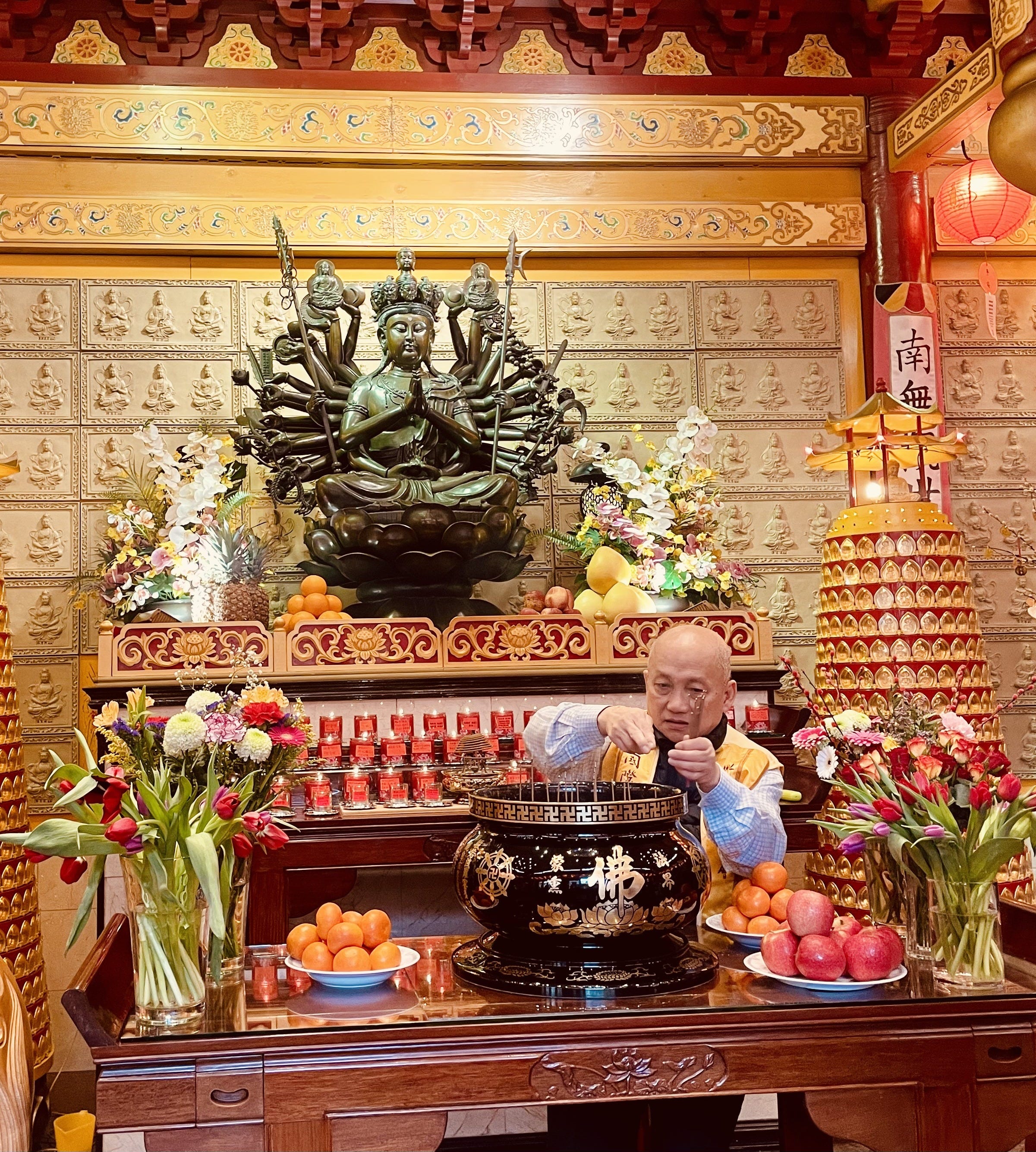
It’s marvellous to be back, hanging out in the old town with my cousin Zoltan and some friends. We had our lunch in a crooked old building called Schreierstoren, the Weeping Tower, built in 1487. Maybe it will lean into the canal, it is so bent. Over bitterballen, we reminisced about Aedine and Béla, then walked down canals and through Chinatown, dotted with red lanterns and to the Chinese Temple, where Avolekitshwara, thousand-armed Buddha of compassion, sat on his throne.
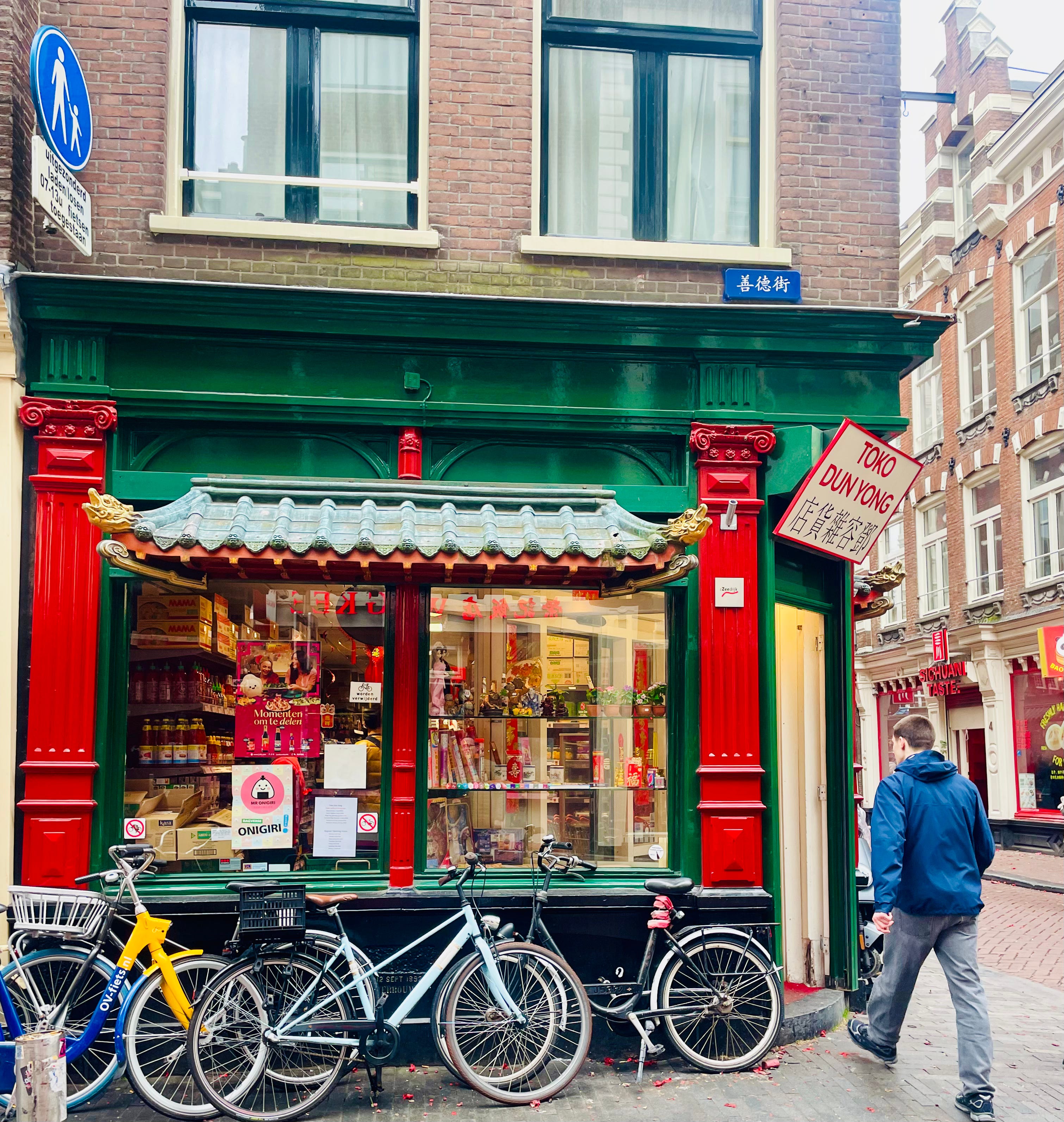
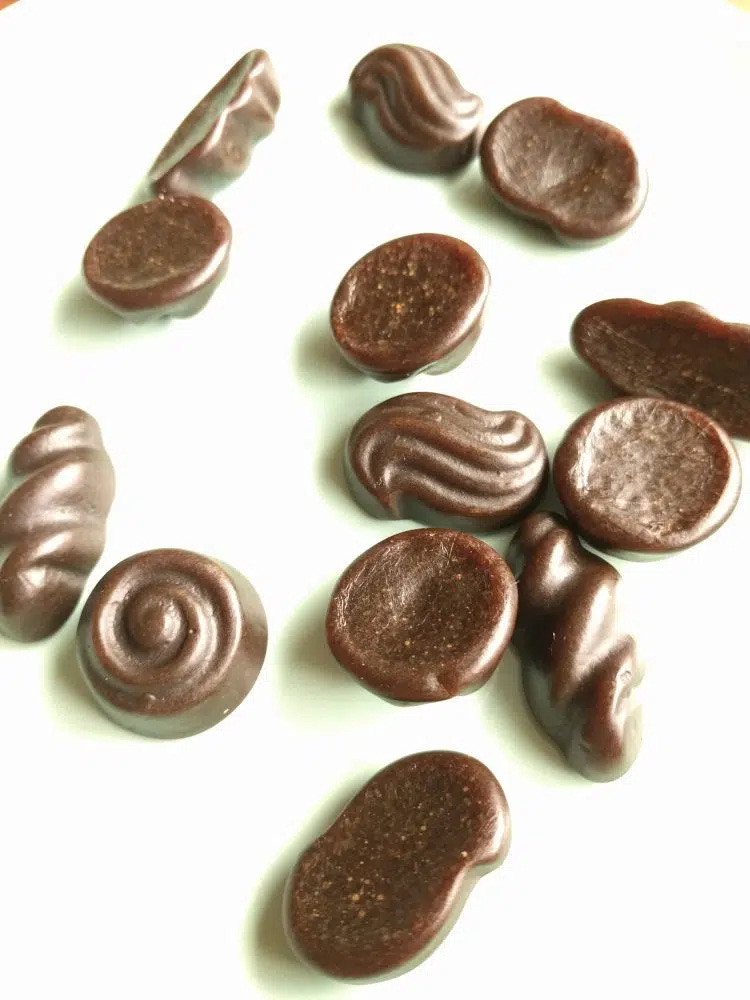
We crossed over a few canals in Red Light District to find the liquorice Drop my Aunt Aedine used to send over in greaseproof paper.
But on the way throught the Red Light District we saw sad, orange ladies displaying themselves in the windows of their brothels, looking askew at the thousands of globetrotters walking past. Tick, Red Light District done. These ladies are stuck in time– frozen, almost. Possibly trafficked, but some say that aspect of the brothel cartels was cleaned up. I don’t think so, by the look on their faces. Far from Geishas who choose their trade, they looked haunted, desperate, staring out from their lairs behind glass.
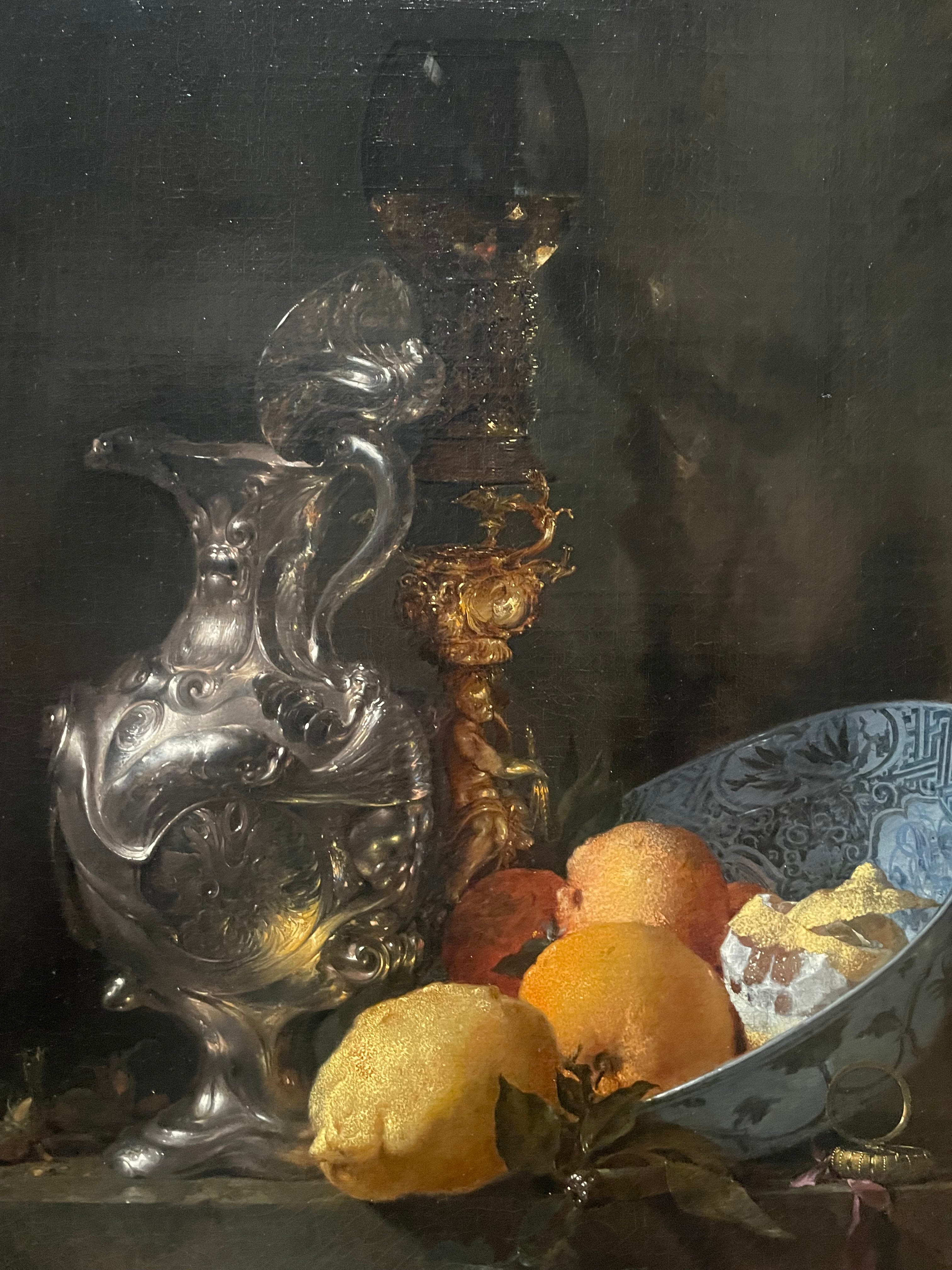
Getting to the Rijksmuseum was hard work, as the Number Two tram constantly eluded us. I hope I’m forgiven for dragging my friends across the city to the Rijksmuseum, which was as full as an airport. I also dragged them up and down Nieuwendijk in search of the place I left my bags in a phone shop, an agent for some weird luggage storage App called Radical Storage. Up and down and up and down we went on Nieuwendijk, an insanely busy shopping street, in search of the elusive phone shop. The street turned into a vortex– I wanted to fling the phone down a gutter. It was spinning and spinning, telling me to go left here, right there, 150m ahead, then changing its crazy mind, then sending me back there and back and up and down the street. Eventually the phone shop appeared, it hadn’t disappeared and didn’t close down before I got there. Cities confuse the hell out of me. Google maps= the worst.
We did find treasures, though. Tourism is so very toxic these days with every European city jaded and scruffy from the trotters and their phones. I suppose I’m as guilty…


Here is the poem I wrote for Aedine, after she passed away. We happened to be there for her birthday, 21st February. Zoltan and I waded through canals to find a church to light her a candle, but none were open. The one in the Red Light District charged 14 Euro to get in. We said no and drifted on to Jordaan to a Tapas bar called Olivia, where the Madridian waitress told me she had lived in Greystones for a year and went to the same school as my son. The shrinking world. Amazing Tapas. See my Ode to Aedine, below:
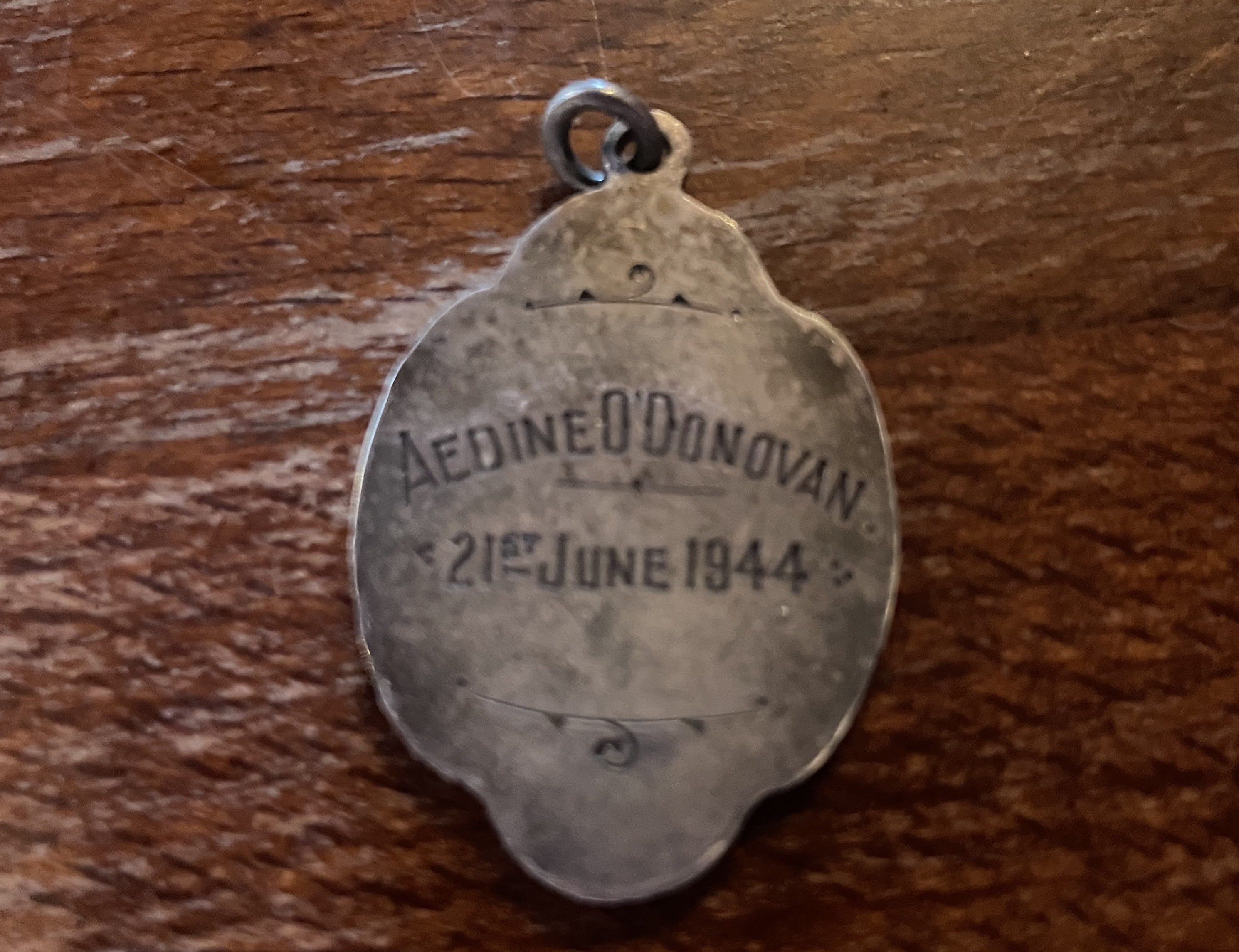
Ode to my Aunt
Aedine, you sat beside me
As my father left us with his bones
And the memory of him–
Which we hoarded.
The shadow of Jim–
Our gentleman of the bombs,
Our host of spies.
Your dear father moving around us
As my father became a distant flicker in the stars.
Béla brought a tray of rattling tea–
The curtain was opened.
Dripping from the leaves of books,
Sliding across the room.
Just us, and memory…
A woman stood on the cnoc
Behind a house where men hid from wars.
Big men, like De Valera, who left his boots out to be polished.
The ghost of a Barry drowned at sea
Who floated in the evening dusk of summer evenings at Tombeagh.
Kitby, standing behind her Adamantine brother
Who sent Ireland into that unforgettable dream
Of love and blood and ancient rage.
And you in your green shawl,
Giggling about the count in Brussels
Whose mad wife threw plates at him across the room.
Three bold men in Dublin chased you
From one end of it to the other.
In exile from this land you loved,
But home, in the bosom of your family.
Over rattling teacups, we say goodbye.
Síofra O’Donovan © 21st January 2012
Aedine on the Line
Aedine on the telephone line
She in Huizen, I in Wicklow.
“Hah,” she would say at some pivotal point.
A Dutch word creeping in which might mean
“Now we move on to something else.”
She left messages on my
Answering machine.
“Jenny, where are you?
Are you still at Siofra’s?
Is the work on the house finished?
Where have you gone?”
Last Sunday, Aedine
Crossed over.
© Jenny O’Donovan (my mother) January 2012.
Wonderful writing
love this Siofra, beautifully written xx